Brussels, 24 September 2026 - Europe’s steel industry could see its annual carbon costs rise from around €3.4bn in 2026 to approximately €8.2bn in 2031 under the proposed revision of the EU Emissions Trading System (ETS), even if ongoing decarbonisation projects are fully implemented.
In its ETS position published today, the European Steel Association (EUROFER) estimates that today’s carbon costs for conventional blast-furnace steel could roughly double to around €100 per tonne by 2030 and above €200 per tonne as of 2031, making it economically unviable. It is therefore calling for a fair and pragmatic transition to the EU’s Carbon Border Adjustment Mechanism (CBAM) that supports steelmakers across Europe.
Under the ETS, European steelmakers pay for their carbon emissions but receive benchmark-based free allowances that provide partial protection against competitors that do not face comparable carbon costs. These allowances are being withdrawn as CBAM introduces a carbon price on imports. EUROFER is calling for a smoother transition between the two systems over the next five years, so that carbon pricing, carbon leakage protection and investment conditions move forward together.
Significant gaps also remain for exports. Foreign producers face the EU carbon cost only on products they sell into the EU, while European producers bear carbon costs regardless of where their products are sold. Yet the EU still lacks an effective structural solution to protect European steel exports and steel-intensive downstream sectors against carbon leakage on global markets.
Axel Eggert, EUROFER’s Director General, said: “Europe’s steel industry is investing billions in the transition and is committed to EU climate neutrality by 2050. Investment decisions have been taken for around 35 million tonnes of low-carbon steel projects, but projects for more than 10 million tonnes of steel capacity have stalled as the business case has deteriorated. We need an ETS that rewards first movers while supporting the whole industry through the transformation. Withdrawing carbon leakage protection too quickly risks undermining the very investments needed to decarbonise. The objective is clear: climate-neutral steel made in Europe.”
EUROFER says carbon pricing and effective carbon leakage protection must go hand in hand. Under the EU’s proposed timetable, benchmark-based free allocation would decline sharply by 2030, outpacing the expected development of the conditions needed for industrial decarbonisation. EUROFER proposes a slower phase-out of free allowances over the next five years, followed by a faster phase-out once these conditions are in place. This would smooth the transition to CBAM while maintaining effective carbon leakage protection for European steel, downstream value chains and exports.
Carbon pricing alone cannot deliver the transformation. Low-carbon investment also requires competitive low-carbon energy, effective trade and carbon leakage protection, lead markets for low-carbon steel, access to ferrous scrap, and adequate investment support.
These enabling conditions will not be available everywhere in Europe at the same time. The transition therefore requires solidarity across Member States, regions and industry. Mr Eggert commented, “Solidarity must be a guiding principle of the transition and the ETS review. Europe needs an ETS that supports first movers without leaving behind companies and regions where the infrastructure and investment conditions are not yet available. That is how we make climate neutrality an industrial success across Europe.”
Download this publication or visit associated links
As EU steel production rises, helping preserve up to 80,000 jobs, the industry reports €3.4 billion in investment decisions, with a further €2.4 billion expected by year-end.
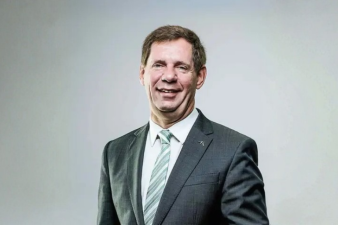
Brussels, 1 October 2026 - The European Steel Association (EUROFER) has elected Geert Van Poelvoorde, Chairman of the Board of ArcelorMittal Europe Steel, as its new President. Taking office today, Mr Van Poelvoorde said stronger home markets across the steel value chain, secure access to export markets and a strong industrial base will be essential to delivering on the European Union’s ambitions for global competitiveness and strategic autonomy.
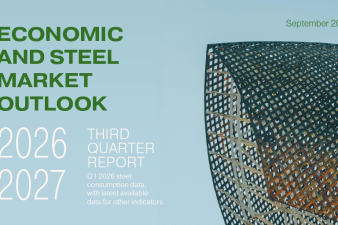
Brussels, 1 October 2026 - Europe’s steel market remains under significant pressure, with exports falling sharply, production at historic lows and demand expected to remain almost flat in 2026, according to the European Steel Association’s (EUROFER) latest Economic and Steel Market Outlook 2026-2027. EU steel exports to third countries fell by 20% in the first half of 2026, with declines across all major export destinations covered by the report. At the same time, crude steel production continued to falter, after reaching a historic low of 125.8 million tonnes in 2025, while apparent steel consumption is forecast to grow by just 0.1% in 2026, before increasing by 2.3% in 2027.
The European Steel Association (EUROFER)
172 Avenue de Cortenbergh
1000 Brussels
Belgium
Email: mail@eurofer.eu
Phone: +32 (0) 2 738 79 20