Press releases » European steel industry and Commission mark 75th anniversary of the Treaty of Paris
European steel industry and Commission mark 75th anniversary of the Treaty of Paris
Recent updates
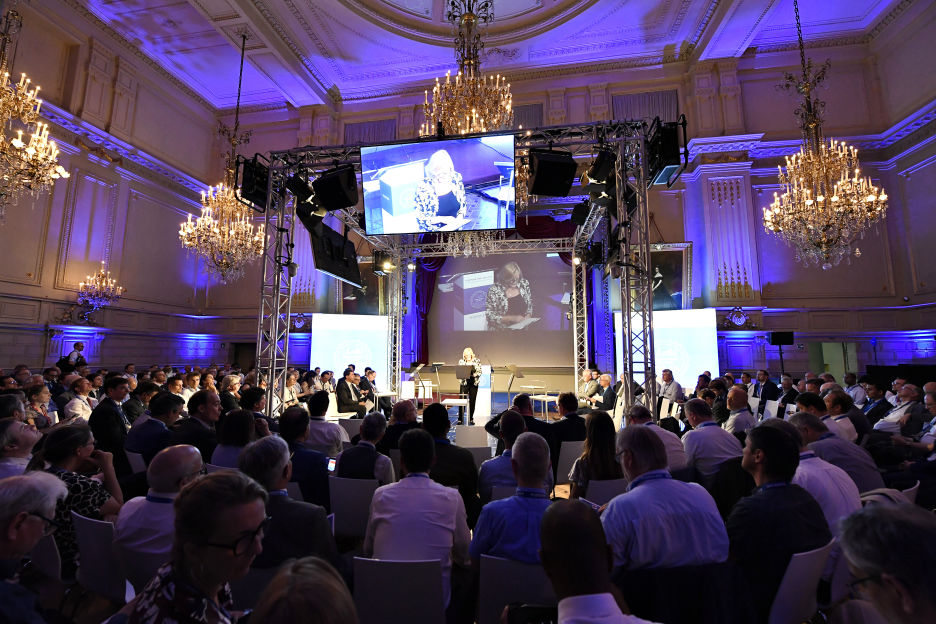
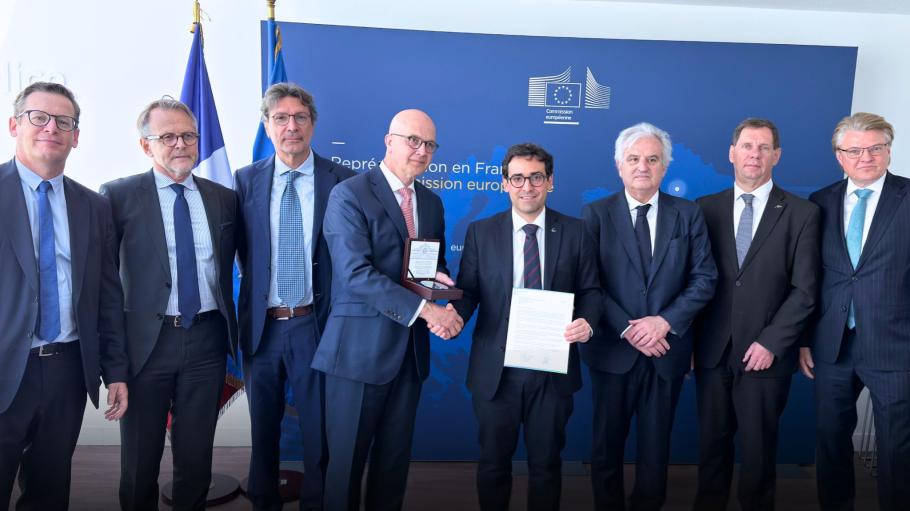
Paris, 24 April 2026 - Seventy-five years after the signing of the Treaty of Paris, the European steel industry met today with the European Commission’s Executive Vice-President Stéphane Séjourné to mark this historic milestone, take stock of Europe’s industrial journey and look at the challenges ahead.
Signed on 18 April 1951 by Belgium, France, Germany, Italy, Luxembourg and the Netherlands, the Treaty established the European Coal and Steel Community (ECSC). It led to the creation of a common market for steel, which entered into operation in 1953, marking a decisive step in Europe’s economic integration.
Meeting in Paris where this process began, industry leaders and the European Commission reflected on the role steel has played in Europe’s development, and its continued importance for competitiveness and resilience. The exchange comes at a time when industrial policy has returned to the forefront of the EU agenda. The industry highlighted the importance of a strong European framework to enable the steel sector and its value chain to contribute to Europe’s security, prosperity and long-term stability.
Henrik Adam, President of the European Steel Association (EUROFER), said: “Seventy-five years ago, Europe took a decisive step by creating a common market for steel. Today, we welcome the renewed efforts of the European Commission to usher in a new era of industrial policy. Progress has been made, but in an increasingly competitive global environment, even more effort will be needed. As in 1951, this will require a strong spirit of cooperation and partnership between industry and European institutions.”
Mr Adam added: “Steel remains fundamental to Europe’s industrial ecosystem, from construction and mobility to defence and energy. A strong European steel sector supports downstream industries, strengthens strategic autonomy and underpins Europe’s global competitiveness.”
The European Commission’s Executive Vice-President, Stéphane Séjourné, remarked, ‘The celebration of the 75th anniversary of the European Coal and Steel Community reminds us how intrinsically intertwined Europe’s and the steel sector’s histories are. Protecting steel plants and workers means protecting the European industry as a whole. We have taken clear steps to protect the sector from unfair competition, with the most robust safeguard clause ever launched. But it doesn’t stop there. We will continue to support steel producers to address the many challenges that characterise this new geopolitical order.’
Participants also included Geert Van Poelvoorde, Vice-President of EUROFER and CEO ArcelorMittal Europe; Tim Di Maulo, Vice-President of EUROFER and Member of the Board, Aperam; Mario Arvedi Caldonazzo, Vice-President of EUROFER and CEO Arvedi Group; Axel Eggert, Director General EUROFER; Raphaël Rey, President A3M (Alliance des Minerais, Minéraux et Métaux); and Bruno Jacquemin, Executive Officer A3M (EUROFER member).
Contact
David French, Spokesperson and Head of Communications, +32 2 738 79 35, (d.french@eurofer.eu)
About the European Steel Association (EUROFER)
EUROFER AISBL is located in Brussels and was founded in 1976. It represents the entirety of steel production in the European Union. EUROFER members are steel companies and national steel federations throughout the EU. The major steel companies and national steel federation of Turkey, Ukraine and the United Kingdom are associate members.
The European Steel Association is recorded in the EU transparency register: 93038071152-83.
About the European steel industry
The European steel industry is a world leader in innovation and environmental sustainability. It has a turnover of around €215 billion and directly employs around 298,000 highly-skilled people, producing on average 146 million tonnes of steel per year. More than 500 steel production sites across 22 EU Member States provide direct and indirect employment to millions more European citizens. Closely integrated with Europe’s manufacturing and construction industries, steel is the backbone for development, growth and employment in Europe.
Steel is the most versatile industrial material in the world. The thousands of different grades and types of steel developed by the industry make the modern world possible. Steel is 100% recyclable and therefore is a fundamental part of the circular economy. As a basic engineering material, steel is also an essential factor in the development and deployment of innovative, CO2-mitigating technologies, improving resource efficiency and fostering sustainable development in Europe.
Steel in Action 2026
Brussels 17 July 2026 - Statement by EUROFER Director General Axel Eggert on the European Commission's proposal to revise the EU Emissions Trading System (ETS):
Brussels, 16 July 2026 - Ahead of the European Commission's review of the EU Emissions Trading System (ETS), the European Steel Association (EUROFER) reaffirmed its support for the EU's climate neutrality objective by 2050, while warning that the ETS can only succeed if it is adapted to market realities and accompanied by the enabling conditions needed for industrial decarbonisation.
The European Steel Association (EUROFER)
172 Avenue de Cortenbergh
1000 Brussels
Belgium
Email: mail@eurofer.eu
Phone: +32 (0) 2 738 79 20